

We Have Been Here Before
The productivity gospel of the AI revolution — and the lesson we keep forgetting

The pasta is cooking. The agent is running. The client message needs a reply. The voice note has been transcribed and is waiting. None of this is happening one after the other — it’s all happening now, in the same moment, in the same kitchen.
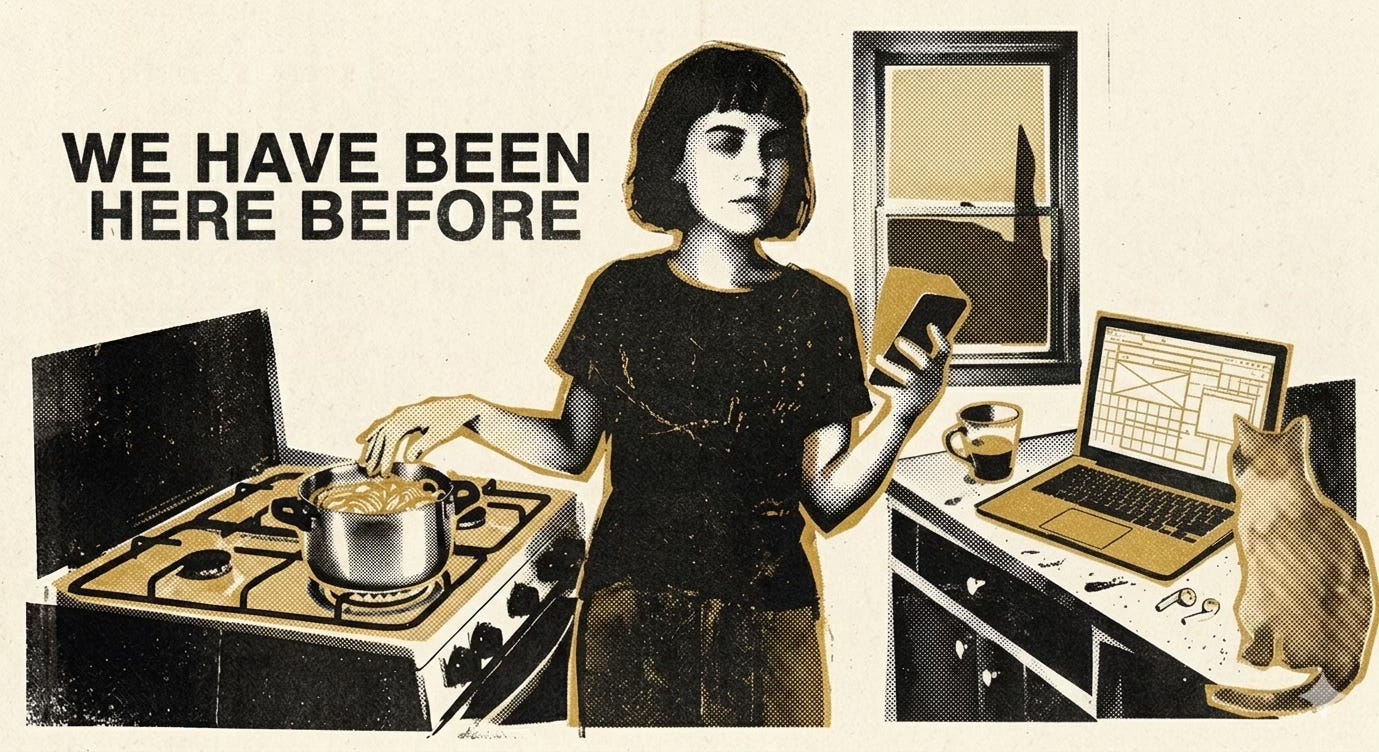
This is not multitasking in the old sense. It’s not switching between tabs. It’s a genuine simultaneity — several threads of work running in parallel, each one real, each one demanding a slice of attention that you don’t quite have to spare. And the strange part? It doesn’t feel like a bad day. It feels like Tuesday.
Somewhere inside that compression, I had a thought: we have been here before.
Not with AI specifically. But with the underlying logic. The idea that better tools equal more output, that more output is always the goal, that the friction we’re removing is the problem — and not, occasionally, the point.
The Industrial Revolution sold something similar. Machines would free workers from drudgery. Efficiency would lift all boats. And it did, eventually, partially — but not before a long detour through exhaustion, displacement, and the gradual discovery that humans are not, in fact, optimisation functions.
It took decades of labour movements, management theory, and hard-won research to arrive at a finding that now seems almost obvious: worker happiness and meaningful work are not soft metrics. They are load-bearing ones. Engaged workers outperform. Burnout destroys productivity from the inside. The Frederick Winslow Taylor model — treat the human like a machine component, measure everything, eliminate waste — was not wrong about efficiency. It was wrong about people.
“We spent a century learning that the goal isn’t maximum output per worker-hour. The goal is sustainable, meaningful, high-quality work. And yet.”
The new productivity gospel
The AI tools being built and marketed right now are, almost without exception, framed around productivity. Dashboards spun up in minutes. Agents running tasks while you sleep. Workflows that compress what used to take a week into an afternoon. The demos are impressive. The time savings are real.
But notice how it’s being sold. Not as “do the same work, better” — as “now you can do more.” The implicit contract is expansion. You get the tool; you give back the time savings in the form of higher output. The ceiling rises. So do the expectations.
For employees inside large organisations, this shows up as restructuring. Teams shrink; remaining members inherit the work. The efficiency gain is real, the benefit is institutional, and the burden falls on whoever is left holding the thread.
For founders and freelancers, the dynamic is stranger and more personal. I know this because I’m living it.
The spiral no one warns you about
Here is what the demos don’t show you: the simultaneity doesn’t stop. It scales.
At first, running an agent while you cook dinner feels like a superpower. You’re reclaiming dead time. The work is happening without you. And then, quietly, “dead time” stops being a category. Every moment becomes potentially productive. The grocery run is a voice note. The commute is a review cycle. The kitchen is a command centre. You didn’t plan it that way. The capability just kept expanding to fill the available space.
The empowerment is real. I can ship things now that I couldn’t have shipped a year ago, across domains where I would otherwise have needed to hire specialists. But here’s what compounds it: the layer around the agents doesn’t transfer.
The decisions still land with you. The accountability for quality, for timing, for whether it actually made sense to do the thing in the first place — none of that is delegable. If an agent produces something wrong, you own that. The speed increases. The cognitive and emotional load of oversight does not decrease at the same rate. Sometimes it increases.
“You can delegate execution. You cannot delegate judgment. And judgment is exhausting.”
There’s also the expectation creep. Once you can do something in a day that used to take a week, the week is gone from your schedule — but it doesn’t become free time. It becomes capacity for something else. You raise your own bar. Your clients and collaborators, consciously or not, raise theirs. The thing you said yes to because the tooling made it feasible quietly becomes the new baseline.
And so you find yourself, again, standing at the stove. Pasta on the hob. Four threads open. Wondering when exactly this became the floor.
What we forgot from the HRM years
The body of knowledge that emerged from decades of human resource management, organizational psychology, and labour economics was genuinely hard-won. It established things like: that intrinsic motivation outperforms extrinsic pressure over time; that autonomy, mastery, and purpose are not luxuries but conditions for sustained performance; that recovery time is not wasted time; that the quality of attention matters as much as the quantity of output.
We seem to be setting that aside.
Not maliciously. The tools are genuinely exciting. The founders building them are, mostly, trying to make work better. But the frame has quietly shifted back to Taylor. The human is again a throughput problem. The question being optimised is: how much can we get out of each person-hour? The answer, with AI: a lot more than before.
Which is not the same as: better.
A different question
I don’t think the answer is to resist the tools. I’m not writing this from a cabin without WiFi. I use AI daily, sometimes hourly. The question I’m sitting with is more uncomfortable than “should we use AI”. It’s: what are we actually trying to optimize for?
If the answer is “maximum output per unit of time,” then the current direction makes sense. Build faster. Ship more. Use every efficiency gain to absorb more work.
But if the answer is “sustainable, high-quality work that doesn’t hollow out the person doing it,” then we need to have a different conversation. One that includes things like: what work do you actually want to do? What does it feel like to spend your days this way? Where is the line between capability and obligation?
The Industrial Revolution eventually produced the welfare state, the eight-hour day, and the weekend. Not because capitalism decided to be nice. But because the alternative produced outcomes: burned-out workers, social instability, diminishing returns — that even efficiency-maximisers found unacceptable.
I wonder what the AI equivalent looks like. And I wonder how long it takes us to get there.
We’ve been here before. We just seem to have forgotten what we learned on the way out.
Inside Tech is a newsletter about technology, the future of work, and the texture of building things. If this resonated, share it with someone thinking through the same questions.